Written by Vinay Upadhyay, Founder of RankSages and Head of AI Search Optimization. In search since 2010, across SaaS, e-commerce, and professional services.
These are the advanced SEO tactics I still reach for in 2026, the ones that move rankings when the basics are already handled. Some are old plays that survived every algorithm update. A few are fragile or overhyped, and I’ll tell you which. No fluff, just what to do and where each one breaks.
Most “advanced SEO” lists are recycled tips dressed up as secrets. This one is honest about what each play does, how to run it today, the mistake people make, and whether it’s worth your time. Skim it all, then use the “where to start” section for the safe entry points.
Content Pruning to Cut Dead Weight
Content pruning means auditing your whole site and removing, merging, or 301-redirecting pages that earn no traffic, no links, and no conversions. The logic is site-level quality and crawl budget. Dead pages drag the whole domain’s perceived quality and waste crawls Google could spend elsewhere.
Here’s how to do it safely.
- In Search Console, open Performance, set the range to the last 12 months, and export every page.
- Pull a backlink report from your tool of choice and flag any URL that has referring domains.
- For zero-traffic pages, check if they still rank for any long-tail query before touching them.
- Merge thin pages into a stronger one and 301 the old URL. Delete only true orphans with no links and no rankings.
The mistake most people make is pruning on traffic alone. They delete a page with zero clicks, not realising it has ten backlinks or ranks position 8 for a phrase nobody checked. Prune on Search Console data plus a backlink tool, never on a single number.
My verdict. Reliable and safe when you cross-check. The gains are quiet but real, especially on bloated sites with years of old posts.
Barnacle SEO for Borrowing Trusted Domains
Will Scott coined “barnacle SEO” around 2011. The idea is to attach yourself to a big, trusted domain instead of trying to rank your own. You get visibility from a Reddit thread, a G2 listing, a YouTube video, or a Medium post that Google already ranks and trusts.
To run it, find the pages already ranking for your query. If a Reddit thread or listicle sits above you, get represented there honestly, as a real participant. Claim your G2 or directory profile, and publish a useful video targeting the same intent.
This tactic got stronger after Google’s Reddit content deal and now that forum posts surface inside AI answers. Here’s the honest part. Barnacle SEO has the shortest half-life on this list, because it rents attention on platforms Google can demote overnight. It also shades into parasite SEO, which Google now targets with its site reputation abuse policy. Stay on the useful-contribution side of that line.
My verdict. Fast wins, real risk. Use it, but never build your business on someone else’s domain.
Reverse Siloing to Route Authority Upward
A normal topic cluster pushes authority down, from a strong pillar page out to supporting articles. Reverse siloing flips the direction. You link from your high-authority informational pages up into the money pages that need ranking power. A blog post that earned 40 backlinks becomes a donor for your product page.
To do it, sort your pages by referring domains, find your top link-earners, and add a contextual link from each into the commercial page you want to rank. Use anchor text that describes the destination, placed high in the copy.
Be honest with yourself here. Reverse siloing is really just internal linking with intent, the same core idea as tactic seven in a fancier name. That doesn’t make it wrong, it makes it something you can start today. My walkthrough on building topic clusters for AI search covers the structure it plugs into.
My verdict. Effective and free. Just don’t pay anyone a premium for the buzzword.
Content Decay Recovery, the Highest-ROI Play Here
Pages lose rankings over time. Competitors publish fresher work, your stats go stale, your screenshots age. Content decay recovery finds those decliners and surgically refreshes them. It’s far cheaper than new content, and in my experience the most underused tactic here.
Here’s how to find your decliners.
- In Search Console, open Performance and set the date range to compare the last 3 months against the previous 3 months.
- Sort by the pages that lost the most clicks or dropped in average position.
- Open each one against the current top-ranking result and note what’s missing or outdated.
- Update the publish date, refresh stats and screenshots, rewrite drifted sections, and add anything the query now expects.
The reason it’s underused is unglamorous. Refreshing an old post doesn’t look as impressive on a monthly report as “5 new articles”. That’s exactly why it’s an edge.
My verdict. Probably the highest-ROI item here. Start with this one.
Search Intent Splitting Done Right
One keyword can hide three different jobs. Take “email marketing software”. Some want it explained, some want to compare, some want to buy. Search intent splitting means you build a guide, a comparison, and a product page, then interlink them so each ranks for its own slice.
To run it, map the query to the three jobs, draft a page for each, and link them together with descriptive anchors so a reader (and Google) can move between them.
Read the actual SERP first. This is where people go wrong. If Google has already blended the intents onto one page type, splitting just creates two pages fighting for the same spot. That’s cannibalisation, and it can drop both. Search the term, look at what ranks, and only split when the results are genuinely mixed page types.
My verdict. Powerful when the SERP supports it, harmful when it doesn’t.
Entity Stacking and How Search Actually Sees Your Brand
Modern search doesn’t just match strings, it resolves entities. Entity stacking means building consistent, corroborated references to your brand, founders, products, and locations across trusted sources, plus matching schema on your own site. The goal is for Google to confidently connect every mention to one real, well-defined thing.
Concrete steps to build corroboration:
- Clean up your Wikidata, Crunchbase, and LinkedIn entries so names, dates, and descriptions match exactly.
- Get mentioned on podcasts, in news, and in reputable directories with the same brand details.
- Add Organization, Person, and Product schema that matches those external facts.
The honest framing. The real concept is entity resolution, and it genuinely reflects how search works now. “Entity stacking” itself is an agency wrapper, not a term in Google’s documentation. I go deeper in my guide to entity SEO, and the case for brand mentions without links explains why unlinked references still count.
My verdict. The underlying idea is real and worth doing. Ignore the jargon, do the corroboration.
Internal Link Sculpting That Still Works
Internal link sculpting means deliberately routing your site’s authority. Pages that need ranking power get more internal links, from your strongest pages, with descriptive anchor text. It’s being intentional instead of leaving your link graph to chance.
A quick history matters here. The original nofollow-based PageRank sculpting was killed by Google in 2009, when they changed how equity flows through nofollow. So forget any tactic built on nofollowing internal links. What survives is the boring, durable version.
- Identify the priority pages you actually want to rank.
- Add links to them from your highest-authority, most-linked pages.
- Use anchor text that describes the target page.
- Trim links to low-value pages so your strong pages don’t leak equity.
My verdict. One of the most dependable tactics on this list. Free, safe, and directly in your control.
Programmatic SEO Without Getting Penalised
Programmatic SEO generates pages at scale from a structured dataset. Think “flights from X to Y” or “best dentists in Z”, where a template pulls in real data for each combination. It works brilliantly when every page carries differentiated information, like live pricing, inventory, or reviews.
It fails, and gets hit by spam policies, when the page is a template with a swapped keyword and nothing else of value. After Google’s March 2024 scaled content abuse update, the bar for unique value rose sharply.
My verdict. High ceiling, high risk. Worth it only if you own differentiated data.
Digital PR SEO for Editorial Links
Digital PR earns editorial links by creating something journalists actually want to cite. That’s usually original data, a survey, a free tool, or a newsworthy angle on data you already sit on. Done well, one national placement can outperform six months of guest posting, because those links are hard to replicate.
How to run a campaign:
- Find a question your industry argues about and answer it with data you can gather.
- Turn the finding into a simple, quotable stat and a clear story.
- Build a landing page for the study, then pitch relevant journalists individually, not a mass blast.
Here’s the honest part. Digital PR is the most expensive and least predictable item on this list. It needs a real story, not a rebranded infographic. Some campaigns land nothing. When one hits, it can reset your whole authority profile.
My verdict. High-effort, high-variance, high-reward. Reserve it for pages that deserve serious links.
Query Fan-Out Optimization for AI Mode
This is the newest tactic here, and the one most tied to how AI search behaves. In Google’s AI Mode, a single prompt is decomposed into many hidden sub-queries, run in parallel, and the answer is synthesised from the union of those results. One prompt can spawn a dozen searches. That decomposition is called query fan-out.
The play is to structure content so distinct sections cleanly answer distinct sub-questions. You want self-contained passages, clear headings, and high factual density, so your page gets cited for at least one fan-out query even if it doesn’t win the whole prompt.
Practical moves:
- Give each sub-topic its own descriptive heading and a passage that stands on its own.
- State facts directly early in each section, so a passage makes sense out of context.
- Cover the adjacent questions a searcher would fan out into, not just the head term.
For the mechanics, see how semantic search and embeddings retrieve passages, and my breakdown of Google AI Mode.
My verdict. Early but worth doing now, since clean passage structure helps classic SEO too.
Where to Start With These Advanced SEO Tactics
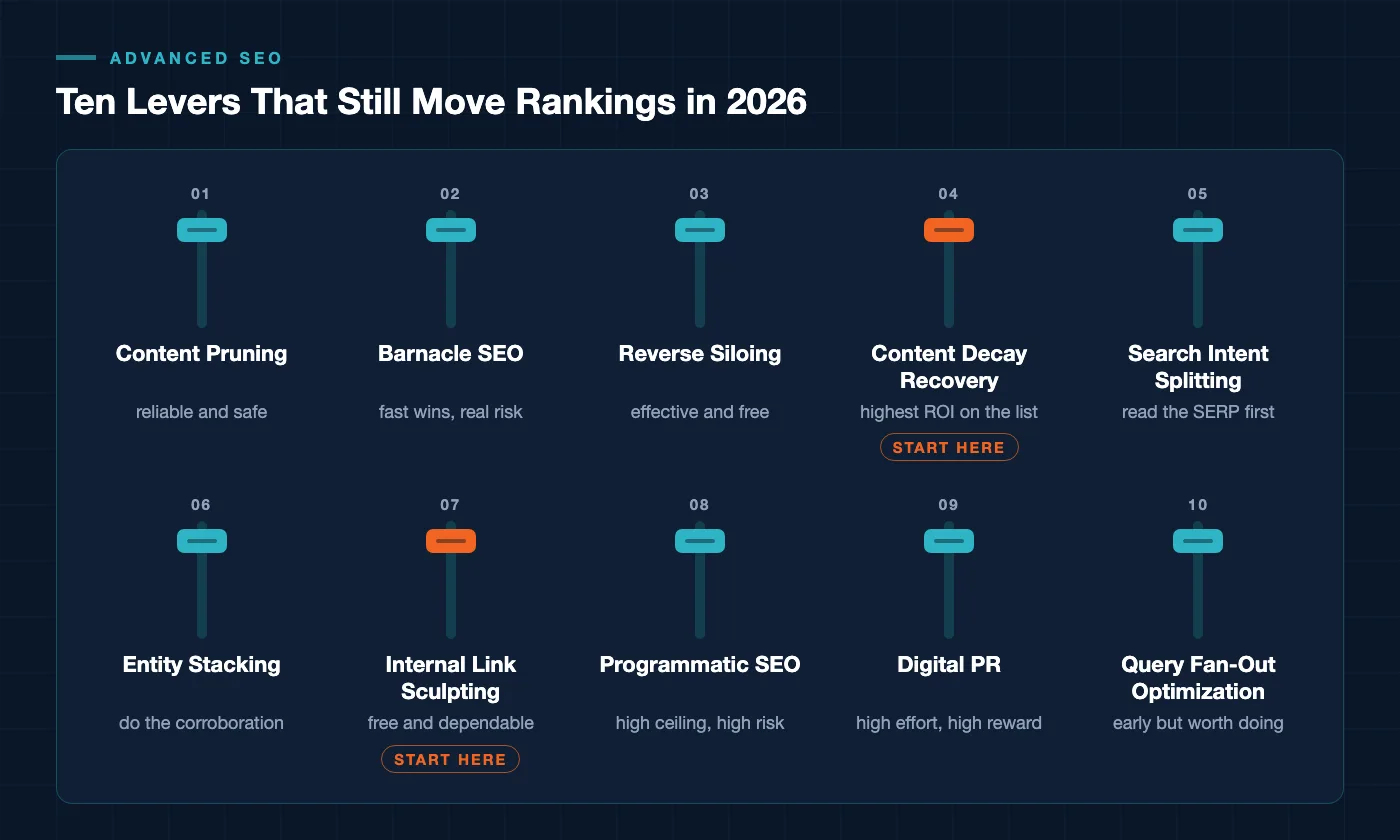
Ten tactics is a lot. If you’re newer, don’t start with the risky ones. Begin with the two safest, highest-return plays.
- Content Decay Recovery. Cheap, fast, low-risk, and usually the biggest quick win.
- Internal Link Sculpting. Free, fully in your control, and dependable.
Once those are habits, layer in Content Pruning, Reverse Siloing, Search Intent Splitting, and Entity Stacking. Save Barnacle SEO, Programmatic SEO, and Digital PR for last, since they carry the most risk or cost. New to a term here? My SEO glossary has plain-English definitions.
Pick one tactic. Run it this week. That beats bookmarking all ten and doing none.
Frequently Asked Questions
What counts as an advanced SEO tactic in 2026
An advanced tactic works with how Google and AI search actually rank and retrieve, like entity resolution, passage-level relevance, and site-wide quality signals. These assume your technical basics and content quality are already in place.
Which of these tactics is the safest to start with
Content decay recovery and internal link sculpting. Both are low-risk, cost little, and stay in your control. You’re improving pages you already own, not gambling on platforms Google can change or penalise.
Is barnacle SEO the same as parasite SEO
They overlap. Barnacle SEO means contributing usefully on trusted platforms so you show up in their rankings. Parasite SEO abuses a host domain’s authority to rank unrelated content, which Google targets with its site reputation abuse policy. Stay on the genuine-contribution side.
How often should I refresh decaying content
Check your decliners monthly in Search Console by comparing rolling three-month periods, and refresh your biggest losers first. Many pages only need a real update once or twice a year, but you won’t know which until you look regularly.
Will programmatic SEO get my site penalised
Only if the pages are thin templates with a swapped keyword. After the March 2024 scaled content abuse update, pages need genuinely unique value like real pricing, inventory, or reviews. With differentiated data behind each page, it’s fine.