Written by Vinay Upadhyay, Founder of RankSages and Head of AI Search Optimization. In search since 2010, across SaaS, e-commerce, and professional services.
Entity SEO is the work of getting Google and AI tools to treat your brand as a real, specific thing, not a lucky match of words on a page. When machines can identify you with confidence, they describe you accurately and cite you, which is now the price of admission to AI answers. This guide shows you how to check where you stand today, then gives you the exact steps to fix it.
The fastest way to check if you’re already an entity today
Before you build anything, find out what Google and AI already think you are. It takes about ten minutes and three tests. Run all three, write down each result, and you’ll know exactly how much entity SEO work sits ahead of you.
Test 1. Search your exact brand name
Open an incognito window and search your brand name on Google. Now look at the right-hand side on desktop.
A pass looks like a knowledge panel with your logo, a one-line description, and links to your profiles, plus your official site sitting at position one with sitelinks. A fail is no panel at all, a panel for a different company that shares your name, or Google offering a “did you mean” for something else. If you fail, Google is still treating your name as a string, not a thing.
Test 2. Look yourself up on Wikidata
Go to wikidata.org and search your brand name. Wikidata is the open database that feeds a lot of what Google and AI systems know about entities.
A pass is a Wikidata item with its own Q-number, a correct one-line description, and a few statements filled in, such as “instance of: business” and your official website. A fail is no item, an empty stub, or an item describing a different organisation. No Wikidata entry is common for smaller brands, and it’s fixable.
Test 3. Ask ChatGPT or Gemini to describe your company
Type a plain prompt into ChatGPT and Gemini: “What is [your brand] and what do they do?” Read the answer like a sceptical customer would.
A pass is an answer that names your real service, your location or delivery model, and your founder without hedging or inventing. A fail is a model that confuses you with another company, makes up services you don’t offer, or says it has no information. Vague or wrong answers here are the clearest sign your entity data is thin.
What a named entity is, and what you do about it
A named entity is any real, uniquely identifiable thing a search engine can store as its own record. Your company is one. So are your founder, your flagship product, your city, and even a concept like “technical SEO”.
Google started thinking this way in 2012, when it launched the Knowledge Graph and described the shift as moving from “strings to things”. Strings are just text. Things are people, places, products, and ideas with records attached. If you want the plain version of any term in this post, our SEO glossary keeps definitions short.
Here’s the action. Make a short list of the entities you need Google to hold cleanly:
- Your organisation — the business itself.
- Your people — founder, named authors, key experts.
- Your products — a software tool, a signature service, a course.
- Your place — the city or region you serve, if location matters.
Pick the two or three that matter most to your business and make them the focus of everything below. You can’t force machines to store a record, but you can hand them one that’s so clean it’s hard to ignore.
How machines tell your brand apart from a similar name
Recognising you is only half the job. Google also has to separate your brand from every other thing with a similar spelling. That second step is disambiguation, and it runs on machine IDs.
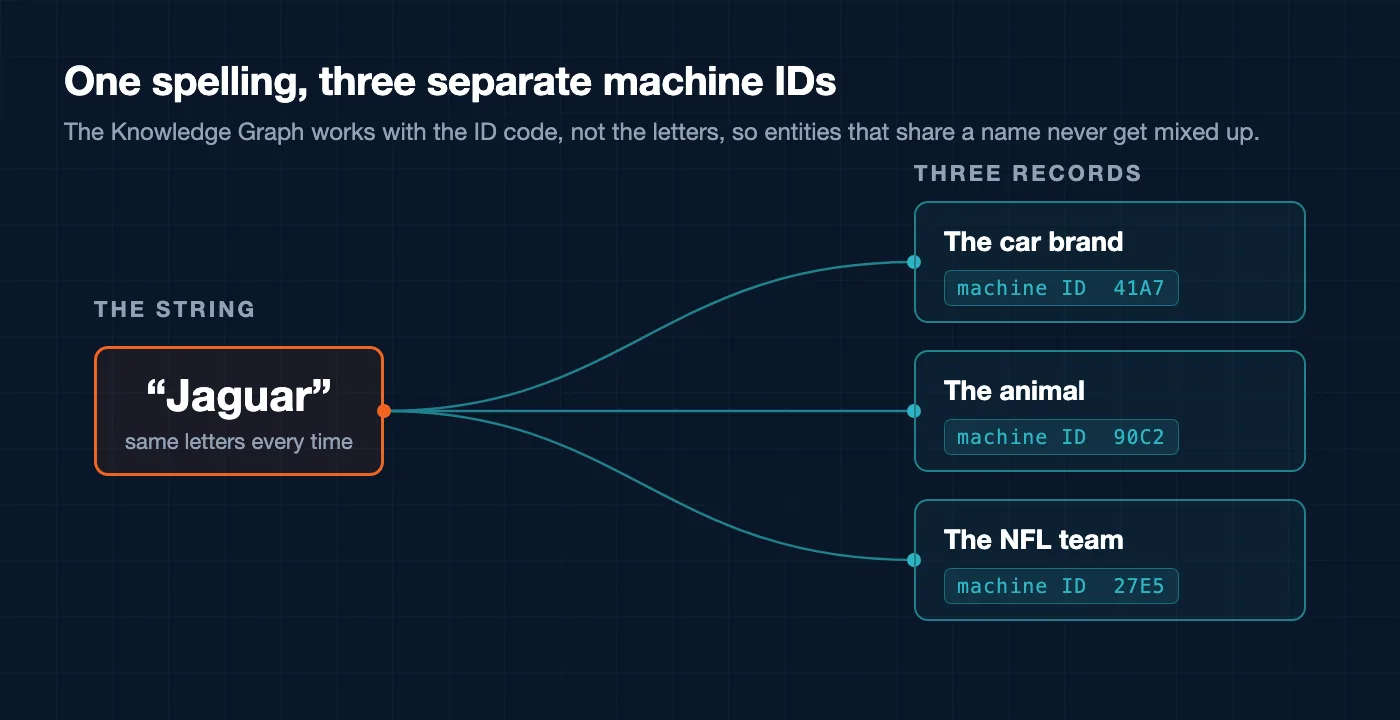
Inside the Knowledge Graph, each entity gets a unique machine ID, a code with no language attached. “Apple” the fruit and “Apple” the company share a spelling but hold different IDs, so the system never mixes them up. It works with the code, not the letters. If you want the full picture, read how the Google Knowledge Graph stores and links entities.
Your action is to give Google the context it needs to attach the right ID to you. Two things do most of the work:
- Surround your brand with the right supporting entities. A dental practice in Leeds should mention “dental implants”, “Leeds”, and named clinicians on the same pages, so the meaning is obvious.
- Claim your machine identifiers where you can. Create or correct your Wikidata item, and link every official profile back to your site. Consistent identifiers help Google decide which record is really you.
Salience versus relevance, and how to win both
Two ideas quietly decide whether a page helps your entity: salience and relevance. Marketers mix them up, so keep them separate.
Salience is how central an entity is to a piece of content. If a page is genuinely about your agency, your brand should be the main subject, not a footnote near the contact form. Google’s own Natural Language API can score entity salience, and you can paste a page into it to see which entity it treats as the star.
Relevance is how strongly your entity connects to a topic or query. A B2B SaaS brand wants a firm link between its name and the problem it solves, built through pages, mentions, and reviews that pair the two.
Here’s what most teams get wrong. They ship a 40-page site where every page touches every topic, so no page clearly owns one thing and salience gets diluted. The fix is focus. Give each important topic a page that is unmistakably about that topic, with your brand as the source answering it.
How to build entity SEO step by step
You don’t need a developer to start. You need consistency and a clear order. Here’s the sequence I work through with brands, and it maps closely to our deeper step-by-step entity building playbook.
Step 1. Pick one canonical entity home page
Choose a single URL that represents your organisation entity. For most brands that’s the homepage or the About page. Every profile, citation, and schema reference you create should point back to that one URL, so Google has a single anchor to attach your record to. Mixed signals across three different “official” pages slow recognition down.
Step 2. Add Organization schema with a full sameAs list
On that canonical page, add Organization structured data in JSON-LD. The part that pulls the most weight is sameAs, a list of your official profiles that tells Google the entity behind all of them is the same one. Here’s a short, usable shape to adapt.
{
  "@context": "https://schema.org",
  "@type": "Organization",
  "name": "RankSages",
  "url": "https://ranksages.com/",
  "description": "AI-first SEO agency helping brands get found in Google and AI answers.",
  "logo": "https://ranksages.com/logo.png",
  "sameAs": [
    "https://www.linkedin.com/company/ranksages",
    "https://www.crunchbase.com/organization/ranksages",
    "https://www.wikidata.org/wiki/Q000000",
    "https://x.com/ranksages",
    "https://www.youtube.com/@ranksages"
  ]
}
Swap in your real values, keep the name and description identical to what you use elsewhere, and validate the markup in Google’s Rich Results Test before you ship it. Add matching Person schema on your author and founder pages using the same pattern.
Step 3. Make your name, NAP, and one-line description identical everywhere
Pick one exact spelling of your brand name, one address and phone format (your NAP), and one short description. Then paste that same block into every profile you own: LinkedIn, Crunchbase, your Google Business Profile, industry directories, and your social bios. Inconsistent details are the single most common reason a brand stays fuzzy, because each variation reads like a possible different entity.
Step 4. Get corroborated on trusted sources
Google trusts you more when independent, established sources say the same thing you do. Build corroboration in a sensible order:
- Create or fix your Wikidata item with correct statements and a link to your canonical page.
- Complete your Crunchbase and LinkedIn company profiles fully, not half-filled.
- Claim your Google Business Profile if you have any local footprint.
- Earn mentions in reputable industry publications and directories that already carry weight.
Each match between these sources and your own site is another vote that you’re one specific, real organisation.
Step 5. Write focused pages that each own one topic
Finish by turning your site into a set of clear answers. Give each core topic its own page, written so your brand is the salient source. Focused pages keep salience high and give AI systems clean passages to quote when they describe what you do.
Why clear entities win in AI answers
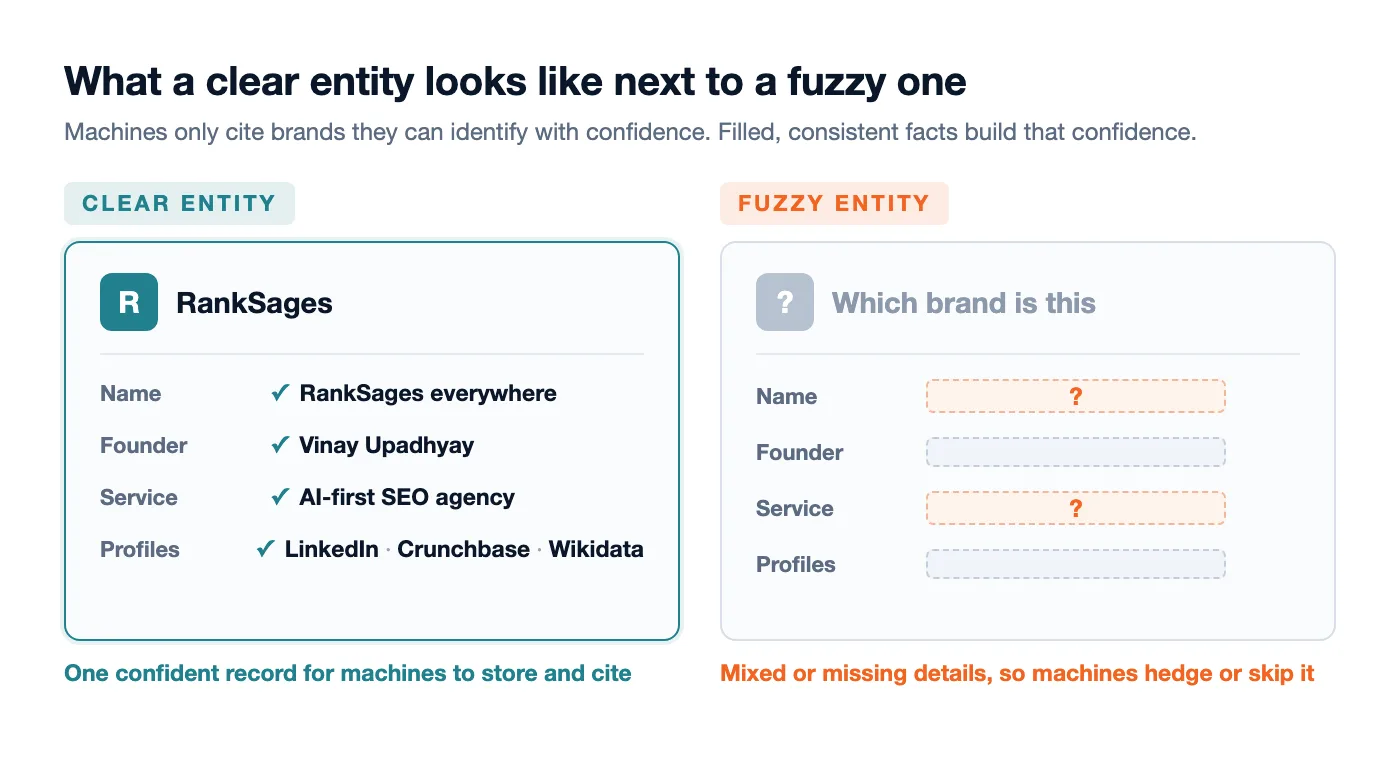
AI answers don’t rank ten links. A model reads, decides, and writes one response, then picks who to cite, and it only cites sources it’s confident about. Clean entity data is what earns that confidence, which is why entity SEO now sits at the centre of AI search optimization.
Get vague and you get skipped for a competitor the model understands better. Get clear and you become the safe, quotable option. Nobody credible can promise you a slot in every answer, but in my experience clear entities get chosen far more often than fuzzy ones across AI search.
Your copy-and-do entity SEO checklist
Run these in order. Tick each one and you’ll have done more entity SEO than most of your competitors.
- Run the three tests: brand-name search, Wikidata lookup, and an AI description prompt. Save screenshots.
- List your two or three most important entities (organisation, people, product).
- Choose one canonical URL to represent your organisation entity.
- Add Organization JSON-LD with a full
sameAslist, then validate it. - Add Person schema to your founder and author pages.
- Lock one exact name, NAP, and one-line description, and paste it everywhere.
- Create or correct your Wikidata item and link it to your canonical page.
- Complete Crunchbase, LinkedIn, and your Google Business Profile in full.
- Give each core topic its own focused page with your brand as the source.
- Re-run the three tests after 90 days and compare against your before picture.
Entity work is slow at first, then sudden. You’ll see little for weeks, then a knowledge panel appears or an AI tool starts describing you correctly. That’s your record clicking into place.
Frequently Asked Questions
Is entity SEO replacing keyword research
No. Keywords still tell you what people want and how they phrase it. Entity SEO sits underneath, making sure Google and AI know exactly who you are when those queries appear. Use both together, not one instead of the other.
Do I need a Wikipedia page to be an entity
No, though a well-sourced reference entry helps. Google builds entity records from many signals, including a correct Wikidata item, consistent details across the web, and structured data on your own site. Plenty of brands become recognised entities without ever touching Wikipedia.
How does Google tell my brand apart from a similar name
Through context and unique machine IDs. Even if two brands share a spelling, Google stores them as separate records with different IDs. It reads the surrounding words, links, and structured data to decide which entity a page actually refers to.
What is the single fastest first step for a small business
Make your core facts identical everywhere: one exact name, one NAP format, and one short description across your site, profiles, and directories. Fix that, add basic Organization schema, and you’ve cleared the most common reason a brand stays fuzzy.
How long does entity SEO take to show results
It varies with your competition and starting point, so I won’t quote a fixed timeline. In my experience the early weeks feel quiet, then recognition arrives in a step change. Consistency is what shortens the wait.