Written by Vinay Upadhyay, Founder of RankSages and Head of AI Search Optimization. In search since 2010, across SaaS, e-commerce, and professional services.
Semantic search is Google matching the meaning behind a query, not the exact words in it. Nail the meaning and you can rank for phrases you never typed on the page. This guide explains embeddings in plain terms, then hands you a page audit you can run in the next hour to find the exact gaps costing you traffic.
What semantic search actually does before you touch a page
Here’s the payoff first. Old search matched letters, so “cheap flights” and “budget airfare” were treated as strangers. Semantic search treats them as the same request and pulls the best answer either way.
Picture a library where books aren’t shelved alphabetically. They’re shelved by what they’re about. Guides on grief sit beside guides on loss. A cookbook sits far from a physics text. Meaning becomes a location, and similar meanings sit on nearby shelves.
Embeddings do that for language. Every word, sentence, and page gets turned into a spot on those shelves so the engine can find neighbors by meaning.
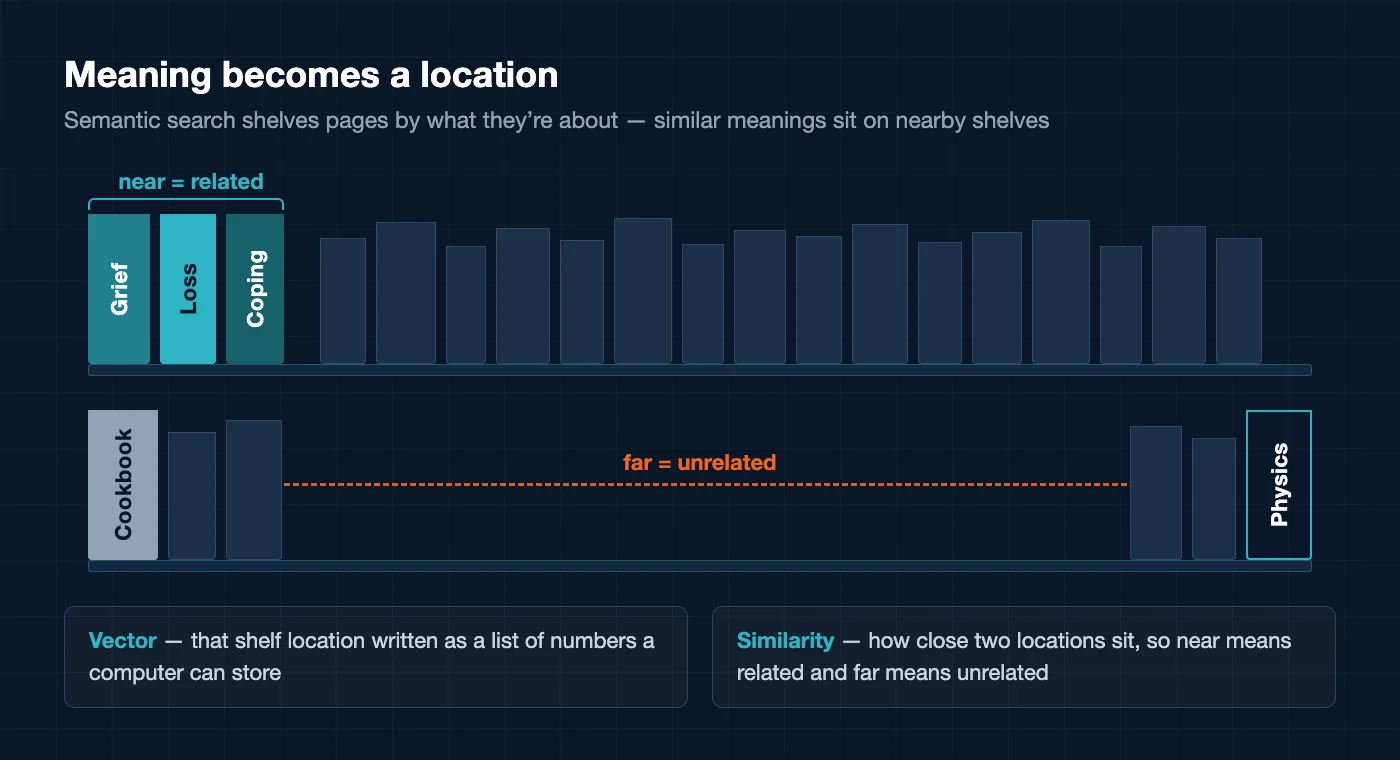
Two terms you can file away in one line each. A vector is that shelf location written as a list of numbers a computer can store. Similarity is how close two locations sit, so near means related and far means unrelated.
Once you picture it that way, a pile of confusing advice clicks into place. Here’s what ends up shelved near what:
- “Dog” sits near “puppy” and “golden retriever.”
- “Bank” for money sits near “loan”; “bank” for a river sits near “shore.” Same word, different neighborhoods.
- “Why is my site slow” sits right next to “how do I fix a slow website.”
How Google learned to read meaning
BERT changed one in ten searches in 2019
In 2019, Google said its BERT update would affect about one in ten searches in the US. That was Google saying out loud that it now weighed meaning over exact wording.
Google’s own example was a search about a traveler going from Brazil to the US, where the tiny word “to” sets the direction. Older systems skipped straight past small words like “to,” “for,” and “no” that flip a whole sentence. BERT reads them.
MUM went multimodal in 2021
MUM arrived in 2021. Google describes it as multimodal and trained across 75 languages, built to understand a question, connect ideas across sources, and help produce an answer.
You don’t need to memorize acronyms to use any of this. If you want plain definitions on hand, we keep them in our plain-English SEO glossary. The behavior underneath both systems is the same idea, meaning as location.
The retrieval step behind every AI answer
Semantic search now decides whether you show up in AI answers too, and most people miss this. Tools like Google’s AI Overviews, ChatGPT, and Perplexity often use retrieval-augmented generation, or RAG.
The order matters. Before the model writes a single word, it retrieves the most relevant passages using embeddings, then answers from them. That retrieval step is a meaning-match, not a keyword-match.
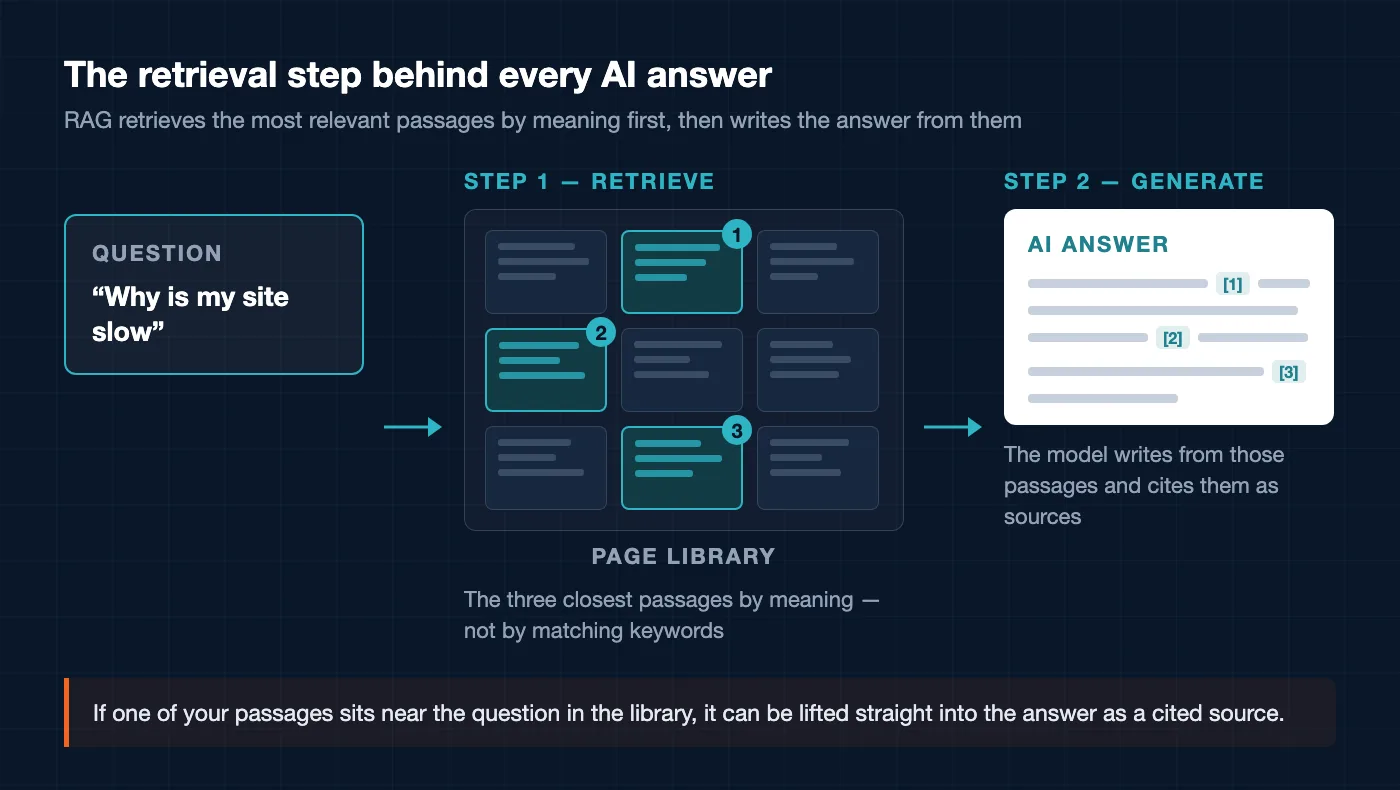
So if one of your passages sits near the question in the library, it can get lifted straight into the answer as a source. Earning those pulls is the core of generative engine optimization, and it starts with how each passage is written.
How to write for meaning, the part that moves rankings
This is where theory turns into a task list. If meaning is a location, your job is to land each page squarely on the shelf next to the questions your buyers ask. Start with an audit you can finish today.
Run this page audit in the next hour
Pick one page that should rank but doesn’t, and its target query. Then work these steps in order:
- Search your target query in an incognito window so your history doesn’t skew results.
- Open the top 3 results and read them fully, not just the intros.
- List every subtopic that all three cover. Shared coverage is the strongest signal of what the query really means.
- Check that list against your page and mark each subtopic present or missing.
- Add the missing subtopics as their own sections, and cut any exact-match phrase you were repeating to hit a density number.
Here’s what that looks like on a real query, filled in by hand:
Target query: "email deliverability"

Subtopics all 3 top results cover:
  - sender reputation
  - SPF, DKIM, DMARC setup
  - spam traps and bounce handling
  - list hygiene / re-engagement

My page right now:
  - sender reputation        [ present ]
  - SPF, DKIM, DMARC         [ MISSING ] <- gap
  - spam traps / bounces     [ MISSING ] <- gap
  - list hygiene             [ present ]

Do next: write the two missing sections, publish, request reindex.
Write passages RAG can lift on their own
RAG pulls passages, not whole pages, so each section has to stand alone. A reader, or a model, should understand a section without the three paragraphs above it.
Give every section a plain heading that names the question it answers. Open with the answer in the first sentence, then support it. Avoid pronouns that point back to earlier text, since a lifted passage loses that context.
One quick test. Copy a single paragraph into a blank doc and read it cold. If it still makes sense with no lead-in, it’s a passage a model can quote. If it reads like “as mentioned above,” rewrite the opening line.
Here’s the same fact written both ways so you can see the difference:
Context-dependent (hard to lift):
  "As we saw above, that's why this step matters
   so much for your own setup."

Self-contained (easy to lift):
  "DMARC tells inbox providers what to do with mail
   that fails authentication, which stops scammers
   from spoofing your domain."
The second version answers on its own, names the thing it’s about, and needs no run-up. That’s the shape a model quotes and a reader trusts. Rewrite your key passages until each one passes that cold-read test.
Use natural variations, not repeated exact strings
Because the engine reads meaning, you get credit for related phrasing without stuffing one exact string. Write “budget airfare,” “affordable flights,” and “cheap tickets” wherever they read well, the way a person actually talks.
Weaving in related entities helps too, since it plants your page in a denser neighborhood. That connection between named things is the whole idea behind entity SEO, and it feeds the same meaning-map semantic search runs on.
Stop keyword-stuffing and stop splitting near-identical pages
Two habits still quietly sink pages. Repeating one exact phrase to hit a density target does nothing, because keyword density isn’t a ranking factor and it moves you no closer to the meaning.
Splitting near-identical pages by keyword variant is the bigger leak. A page for “cheap CRM software” and another for “affordable CRM tool” now compete for the same shelf and dilute each other. Merge them into one strong page. That instinct is why modern topic clusters for AI search beat a pile of thin variant pages every time.
Sanity-check any draft in four steps
You don’t need software to write for meaning. You need a habit. Before you hit publish, run any draft through these four checks:
- Name the one idea. If you can’t say what the page is about in a sentence, neither can the engine.
- List the next questions. Write down what a reader would ask right after, then confirm the page answers them.
- Compare against the top 3. Search the query, read the leaders, and note the shared subtopics you skipped.
- Add the neighbors, cut the repeats. Fill the gaps and delete the exact-match padding you were leaning on.
None of this asks you to think like an engineer. It asks you to cover a subject the way a helpful expert would. The machine has quietly caught up to that standard, and in my experience the sites that write this way tend to hold up as search keeps shifting.
Frequently Asked Questions
Does semantic search mean keyword research is dead
No. You still research what people search for and the words they use. You just stop writing to exact-match strings and start covering the meaning and the related questions behind them.
Do I need to understand vectors or math to optimize for this
No. The practical takeaway is short. Cover a topic and its related ideas well, write for intent, and keep each passage clear. The math stays under the hood where it belongs.
What is an embedding in one sentence
It’s a way of turning a word, sentence, or page into a list of numbers that captures its meaning, so things that mean the same thing sit close together.
How does semantic search affect showing up in AI answers
AI tools often retrieve source passages by meaning first, then write from them. Pages with clear, self-contained passages that match the question are more likely to get pulled in and cited.
Does keyword-stuffing still hurt my rankings
It doesn’t help, and it can read as spam to readers and engines alike. Repeating a phrase won’t move you closer to the meaning, while thorough, natural coverage often will.