Written by Vinay Upadhyay, Founder of RankSages and Head of AI Search Optimization. In search since 2010, across SaaS, e-commerce, and professional services.
Brand mentions are any time your name shows up in text, even with no link attached. They still teach Google and AI models what you do and who you sit next to. This guide shows you how to earn them, track them, and prove they are working, starting with a five-minute test you can run today.
What brand mentions without links actually are
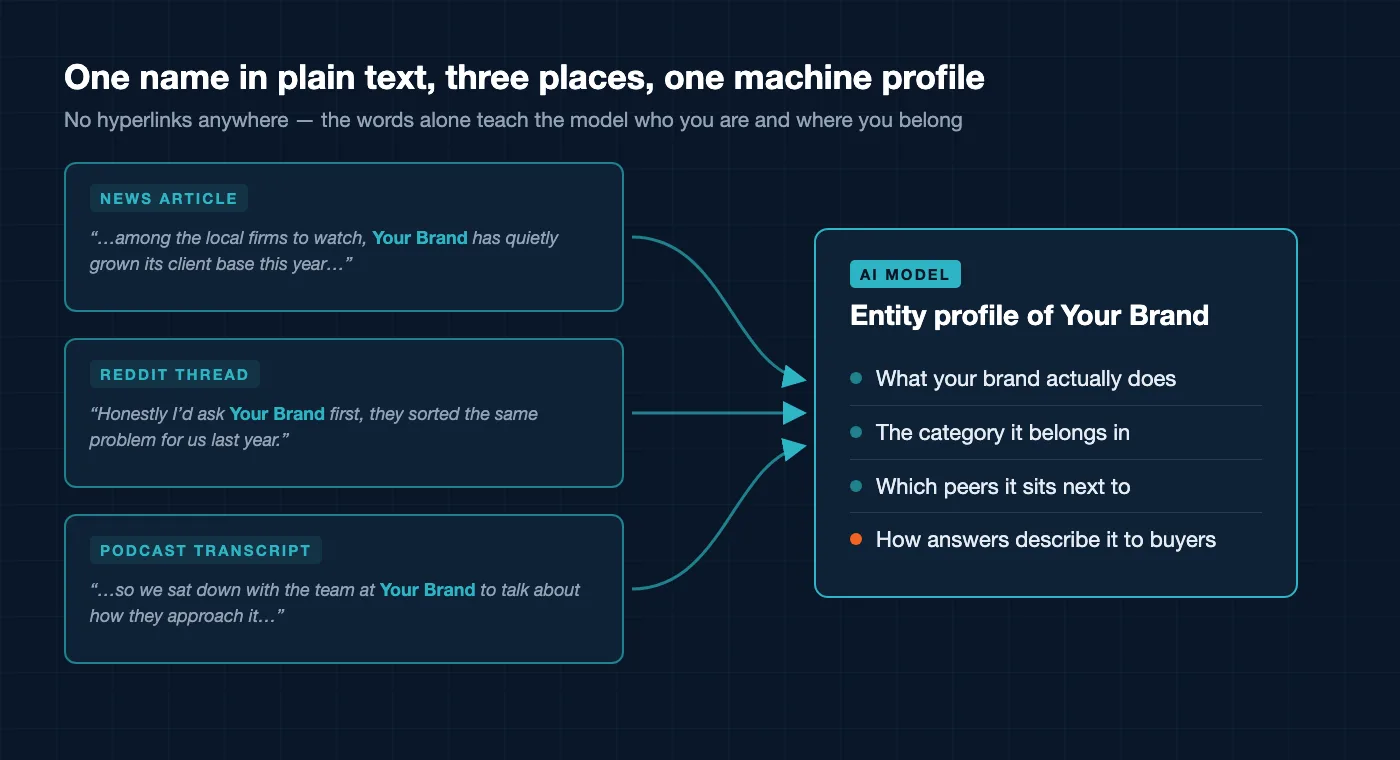
Ask ChatGPT to recommend an accountant in your city. It will name firms it has never linked to once. Plain-text mentions taught it who those firms are.
A linked mention wraps your name in a clickable hyperlink. An unlinked mention is the same name in plain text with nothing to click. SEOs chased the first kind for twenty years and threw the second kind in the bin.
That habit is now costing you. Language models read text, not your link graph. Every unlinked mention still feeds the profile a model holds of your brand.
Co-citation and implied links, explained fast
Two old ideas explain why plain-text mentions carry weight. Learn them in one read and you will spot the opportunity everywhere.
Co-citation is when two brands get named together often enough that engines start associating them. Say a Leeds marketing blog names your agency in the same paragraph as two well-known SEO firms. No links anywhere. A reader, a crawler, and a model all file you next to those firms.
Implied links are mentions that behave like a link without being one. Your brand name sitting inside a relevant article does some of the job a hyperlink would do, minus the click.
Here is the practical version. A dental practice in Leeds gets named in a local “best clinics” story with zero links. That story still tells search engines and AI models that the practice belongs in the dental category for Leeds. This is the base layer of entity SEO, where you teach machines an accurate profile of who you are and what you do well.
The honest truth about what Google has and hasn’t said
I will not hand you a percentage, because nobody honestly has one. Google has never published how much an unlinked mention counts. Anyone quoting you a hard number is guessing.
What exists is a Google patent that describes “implied links” and treats mentions as a possible ranking signal. The late Bill Slawski spent years reading and documenting patents like this at his site SEO by the Sea.
A patent is not a confirmed live factor. Google files thousands of them and ships a small fraction. Read this one as proof the idea was taken seriously, not as settled fact.
The evidence you can actually trust is sitting on your screen. Watch how ChatGPT or Perplexity describes a brand, then read what the open web publishes about it. The two usually match, because models describe a brand the way the open web talks about it. That match is observable, repeatable, and free to check.
Run this share of voice test in the next five minutes
Before you spend a penny on outreach, find out where you stand. This test shows whether models already know you, and how you compare with rivals. Open ChatGPT, Perplexity, and Google AI Overviews in three tabs, then run the same prompts in each.
- Ask for the category, not your brand. Type “Who are the best [your service] providers in [your city or niche]?” Do not mention yourself. See if you appear at all.
- Count the names. Write down every brand each tool lists. If three rivals show up in all three tools and you show up in none, your share of voice is the problem, not your website.
- Ask the model to describe you. Type “Describe [your brand] in one sentence.” If the sentence is wrong or thin, your associations are off.
- Repeat weekly for a month. AI answers shift, so one reading tells you little. Log the results in a simple sheet and watch the trend.
Here are the exact prompts to paste, so you run the same test every time.
Who are the best [service] providers for [audience] in [location]?
List 8 and say why each made the list.

Describe [your brand] in one sentence.

What is [your brand] known for, and who does it compete with?
A good result is your name appearing unprompted, described accurately, next to peers you respect. A bad result is silence or a vague, wrong summary. Either way, you now have a baseline to beat.
Earn brand mentions with this five-step playbook
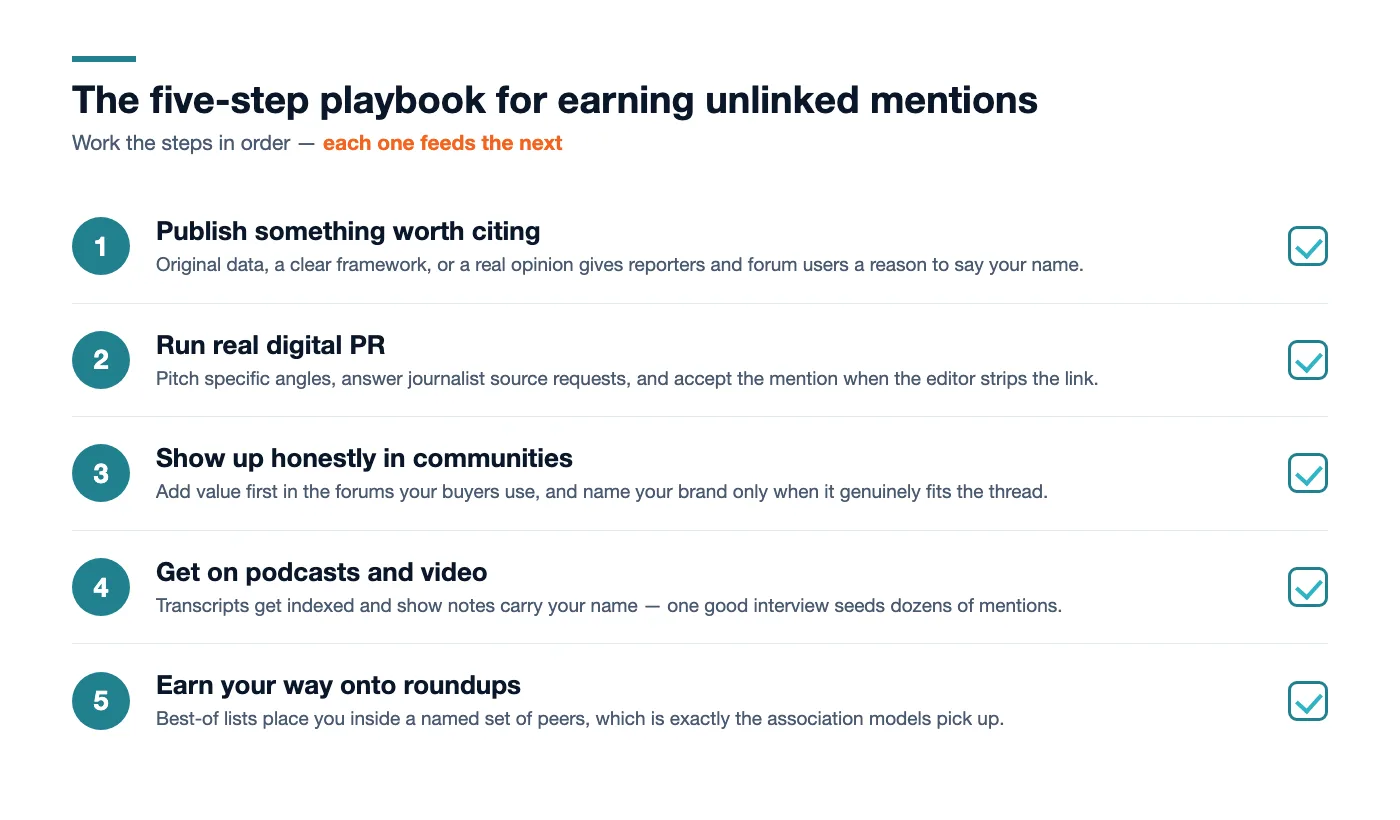
You cannot buy good associations. You earn them by being genuinely useful and genuinely visible. Work these five moves in order, because each one feeds the next.
1. Publish something worth citing
Give people a reason to say your name. Original data, a clear framework, or a real opinion all work. A 40-page B2B SaaS site does not need a hundred blog posts. It needs one survey, one benchmark, or one strong point of view that reporters and forum users want to reference.
2. Run real digital PR
Pitch reporters with a specific angle tied to what you published. Answer journalist source requests where you have real expertise. Ask for a link every time, then accept the mention when the editor strips it. The mention still did its job.
3. Show up honestly in communities
Spend time in the subreddits and forums your buyers actually use. Answer questions, add value first, and name your brand only when it genuinely fits the thread. One trusted recommendation in a real discussion outweighs fifty spammy drops.
4. Get on podcasts and video
Book founder interviews on shows your audience listens to. Transcripts get indexed and scraped, and show notes carry your name across the web. A single good interview seeds dozens of mentions from one afternoon of work.
5. Earn your way onto roundups
Every category runs “best of” lists each year. Get included in them. These roundups place you inside a named set of peers, which is exactly the association models pick up. This is where classic link building strategies and modern mention-earning use the same outreach muscle, just a wider scorecard.
Not every mention pulls the same weight. Aim your effort at sources that real people and models actually read.
- Press and news. A journalist naming you places you next to your category, link or not.
- Podcasts and YouTube. Audio and transcripts spread one mention into many.
- Reddit and forums. Genuine recommendation threads carry unusual trust, and the links are usually nofollowed anyway.
- Review sites. G2, Clutch, and niche directories tie your name to a category and a sentiment.
- Industry roundups. “Best of” lists group you with peers for a topic.
How to track brand mentions and AI citations
You cannot improve what you do not watch. Split your tracking into two jobs, because they answer different questions.
Set up mention monitoring
Create brand alerts for your exact name and its common misspellings. Google Alerts is free and catches some of it. A paid monitoring tool catches far more, including social posts and forum threads that alerts miss.
Log each web mention by source, date, and tone. You are watching three things over time: who names you, where, and whether the words around your name read positive or negative.
Track AI citations separately
Web mentions and AI answers are not the same thing. A page can name you every week while ChatGPT still ignores you. So track both buckets.
- Web mentions. Who is naming you, where, and in what tone.
- AI citations. Whether models actually name or cite you inside their answers.
For the second bucket, lean on AI citation tracking to see whether your mentions are turning into visibility inside the answer engines. Check monthly, watch the trend, and ignore any single week. If you care about broader AI visibility, this is the number that tells you the mentions are landing.
One last connection. If your goal is to get featured in ChatGPT and Perplexity, this groundwork is how you get there. Those tools cite what the open web already talks about, so earning mentions feeds the exact source they read from.
Frequently Asked Questions
Do brand mentions without links help SEO
Google has not confirmed the exact weight, so treat any specific number with suspicion. What we can say is that mentions build the entity associations that show up in both search and AI answers. They are a real signal you can influence, even if you cannot measure it precisely.
What is the difference between a brand mention and a backlink
A backlink is a clickable link that passes an established ranking signal and can send referral traffic. A mention is just your name in text. Both build associations, but only the backlink passes link equity, so treat them as teammates rather than rivals.
Can AI tools use mentions that have no link
Yes. Language models learn from text, not from your link graph. An unlinked mention in an article, a review, or a podcast transcript still teaches them what your brand does and who it competes with.
How do I track brand mentions
Start with brand alerts and a monitoring tool for web, social, and forum mentions. Then layer in AI citation tracking to see whether models actually name you in their answers. Reviewed together, the two show the full picture.
How many brand mentions do I need
There is no public target, and anyone who gives you one is inventing it. Aim to close the share of voice gap with the competitors who already appear in AI answers for your topic. Relative presence matters more than a raw count.