Written by Vinay Upadhyay, Founder of RankSages and Head of AI Search Optimization. In search since 2010, across SaaS, e-commerce, and professional services.
Entity building is the work of turning your brand from a vague string of words into a specific thing Google can recognise, trust, and connect to other known facts. Do it well and you start showing up in AI answers and Knowledge Panels, not just blue links. This is the exact playbook I use, five steps you can start today.
Most guides on this topic stay abstract. This one won’t. For each step I’ll tell you the page to edit, the code to paste, or the profile to claim, and what a good result looks like versus a bad one.
If you want the theory behind the practice first, read our primer on entity SEO. Everything below assumes you already believe recognition beats repetition. Now let’s make you recognisable.
Step 1 — Pick one page that defines your entity
Choose a single canonical home for your entity. For a business, that’s your homepage or your About page. For a personal brand, it’s your author or bio page. Pick one and commit.
Then make that page state four things in plain sentences a machine can read without guessing:
- Your exact name, the way you want it recorded everywhere.
- What you actually do, in one clear line.
- When you were founded, or when you started.
- Where you operate, whether that’s a city, a country, or fully remote.
Here’s the mistake I see most. Brands hide these facts inside a slogan. “We ignite bold growth journeys” tells a search engine nothing. “RankSages is a remote SEO agency founded in 2019, working with clients across the UK, US, and Singapore” tells it everything.
Write the plain version. You can keep the slogan as a headline, but put the factual sentence in the body text where crawlers and language models read it.
Step 2 — Add Organization and Person schema
Sentences help. Structured data removes the guesswork entirely. Schema markup tells Google, in machine terms, “this is an Organisation, here is its name, and here are its verified profiles elsewhere.”
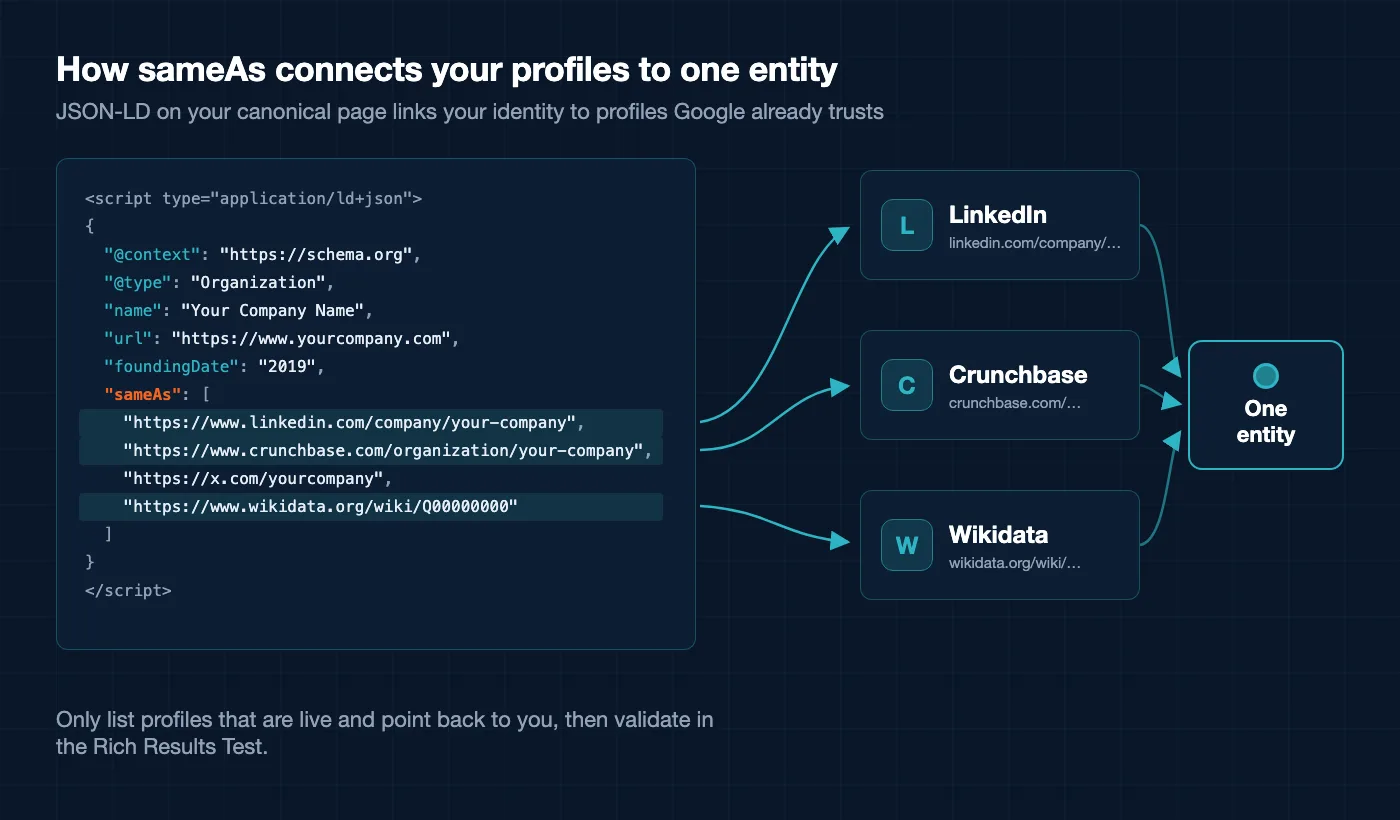
The property that does the heavy lifting for entity building is sameAs. It links your on-site identity to your profiles on sites Google already trusts, which is how a scattered web presence becomes one connected record.
Add two blocks of JSON-LD to your canonical page. One for the organisation, one for the founder. Swap the placeholder URLs for your real, live profiles only.
<script type="application/ld+json">
{
  "@context": "https://schema.org",
  "@type": "Organization",
  "name": "Your Company Name",
  "url": "https://www.yourcompany.com",
  "foundingDate": "2019",
  "description": "One-line factual description of what you do.",
  "sameAs": [
    "https://www.linkedin.com/company/your-company",
    "https://www.crunchbase.com/organization/your-company",
    "https://x.com/yourcompany",
    "https://www.wikidata.org/wiki/Q00000000"
  ]
}
</script>

<script type="application/ld+json">
{
  "@context": "https://schema.org",
  "@type": "Person",
  "name": "Your Founder Name",
  "jobTitle": "Founder",
  "worksFor": { "@type": "Organization", "name": "Your Company Name" },
  "url": "https://www.yourcompany.com/about-us/",
  "sameAs": [
    "https://www.linkedin.com/in/your-founder",
    "https://x.com/yourfounder"
  ]
}
</script>
Only list profiles that exist and point back to you. A sameAs entry for a dead account or a page that never mentions your brand does nothing, and can read as sloppy. Validate the markup in Google’s Rich Results Test before you move on.
If schema is new to you, our schema markup guide walks through the syntax slowly. For the bigger picture on why these IDs matter, our explainer on how the Knowledge Graph works covers the machine-ID logic behind it.
Step 3 — Make your name and details match everywhere
Google confirms an entity partly by seeing the same facts repeated consistently across the web. Contradict yourself and you slow that confirmation down. This is the least glamorous step and the one that quietly wrecks the most brands.
Lock three things and keep them byte-for-byte identical wherever they appear:
- Your name. One spelling, one capitalisation, one legal-versus-trading choice.
- Your NAP (name, address, phone), if you have a physical presence or a support line.
- Your one-line boilerplate description, reused word for word.
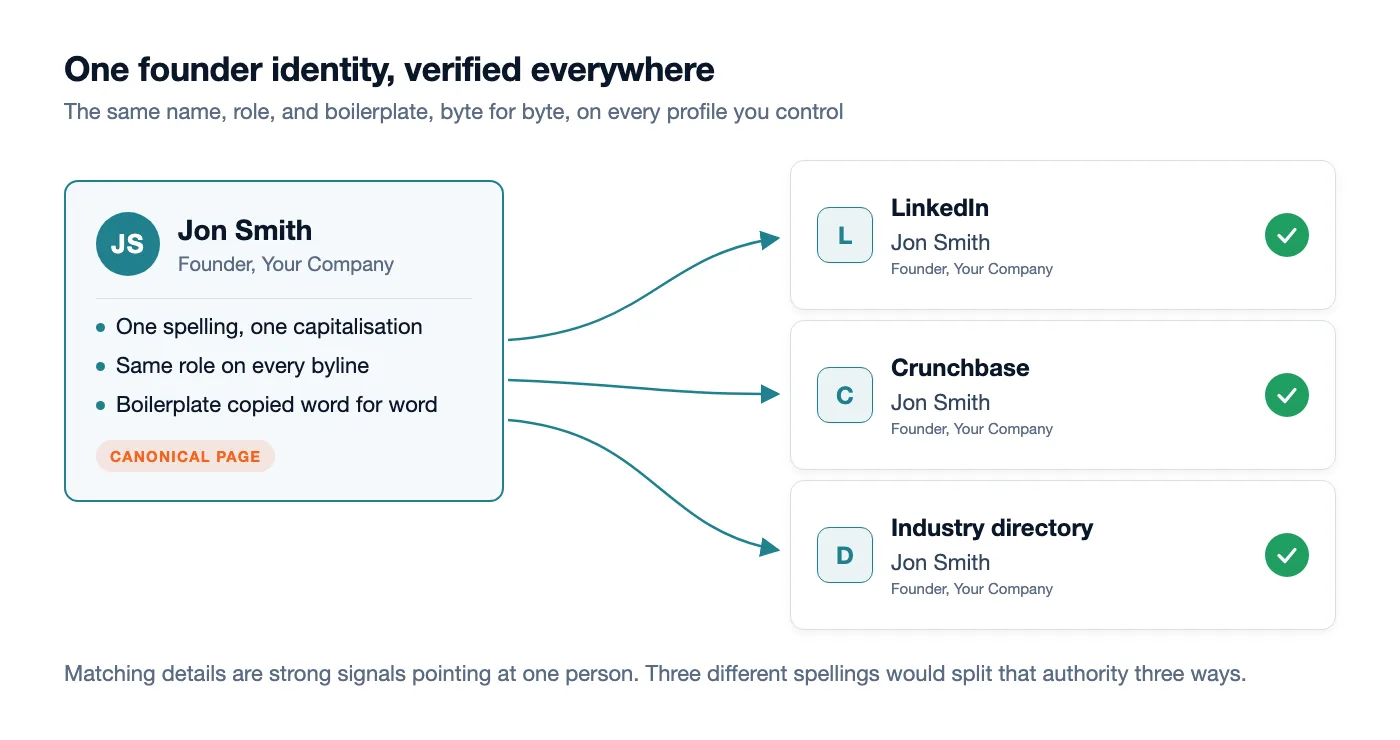
Here’s the trap I call the three spellings problem. Say your business is written as “RankSages” on your site, “Rank Sages” on LinkedIn, and “Ranksages Ltd” on Crunchbase. To you those are obviously the same company. To a machine building a record, that’s three weak signals pointing at three fuzzy candidates instead of one strong signal pointing at you.
The same problem hits people. A founder listed as “Jon Smith”, “Jonathan Smith”, and “J. Smith” splits their own authority three ways.
Run this quick consistency checklist across every property you control:
- Exact brand name, matching capitalisation and spacing.
- Same address format, digit for digit, including suite or unit.
- Same phone number format and country code.
- Identical one-line boilerplate, copied not paraphrased.
- Founder name spelled the same on the site, LinkedIn, and every byline.
Fix the mismatches you find. Pick the canonical version from Step 1, then update your social profiles, directory listings, and author bios to match it exactly.
Step 4 — Get represented in trusted sources
Your own site claims who you are. Trusted third-party sources corroborate it. Google weights that corroboration heavily, so this is where entity building starts to compound.
Work through these in order of effort:
- LinkedIn. A complete company page and a real founder profile. Low effort, and almost everyone qualifies.
- Crunchbase. Claim or create your organisation entry with accurate founding date, description, and links.
- Reputable industry directories. The credible ones for your sector, not spammy link farms. Quality over quantity.
- Wikidata. Only if you genuinely qualify under its notability rules. Wikidata is an open, structured database that many systems read, and a clean entry can strengthen your record.
One firm rule governs this whole step. Every profile must be accurate, live, and consistent with Steps 1 to 3. Do not fabricate coverage, invent awards, or stuff a directory with a listing you’ll never maintain.
A word on Wikidata specifically. Anyone can technically add an item, but items about non-notable businesses get removed, and gaming it can backfire. If you don’t clearly meet the bar yet, skip it and revisit once you’ve earned genuine third-party coverage.
Every new trusted profile that carries your correct name and links back to your canonical page adds another sameAs candidate and another consistent mention. That’s the flywheel you’re building.
Step 5 — Earn mentions that reinforce the associations
The final step moves from profiles to context. You want your brand mentioned near the topics and entities you want to be known for, so Google strengthens those associations.
Think about the connections you’re trying to cement. A dental practice in Leeds wants its name to appear alongside “dental implants” and “Leeds”. A B2B SaaS founder wants their name to appear alongside their category and their product.
You reinforce those links through mentions, and a mention does not need to be a link to count. Aim for a few of these:
- A guest article or podcast where you’re introduced by name and role.
- A quote in an industry roundup that names you and what you do.
- Coverage in a trade publication your audience already reads.
- An expert contribution to a resource in your field.
Notice the pattern. Each one places your correct name next to the right supporting topics. That surrounding context is how a machine decides which “Jaguar” or which agency you are, so consistency from the earlier steps pays off here.
We go deeper on this in our piece on earning recognition through AI search optimization, where mentions and entity signals sit at the centre of the work.
Your entity building checklist
Here’s the whole playbook on one screen. Work top to bottom.
- Pick one canonical page and add a plain factual description of your entity.
- Add Organization and Person schema with an accurate
sameAslist. - Make your name, NAP, and boilerplate identical everywhere.
- Claim accurate, live profiles on LinkedIn, Crunchbase, and trusted directories.
- Earn mentions that place your name next to the right topics.
Start with Step 1 today. Want a second opinion on where your entity stands right now? Our free AI search audit shows how clearly machines currently understand your brand.
Frequently Asked Questions
How long does entity building take to work?
It varies with your competition and starting point, so I won’t quote a fixed number. In my experience the first weeks feel quiet, then recognition arrives in a step change once your signals line up. Consistency across the five steps is what shortens the wait.
Do I need a Wikipedia page to become an entity?
No. Google builds entity records from many signals, including consistent details across the web, structured data on your own site, and trusted profiles like LinkedIn and Crunchbase. Plenty of brands become recognised entities without ever touching Wikipedia or Wikidata.
What is the difference between entity building and link building?
Link building chases links to pass authority. Entity building makes your brand a specific, consistent, well-described thing that machines can identify. The two overlap, since some mentions carry links, but entity work counts unlinked mentions and structured data that pure link building ignores.
Which schema type should a personal brand use?
Use Person schema for yourself and Organization schema for your business, then connect them with the worksFor property. Give each one its own sameAs list of live profiles. That keeps the human and the company as two clear, linked records rather than one blurry one.
Can small businesses build a strong entity?
Yes. None of the five steps needs a big budget or a technical team. A consistent name, a clear canonical page, valid schema, and a few accurate profiles put most small businesses ahead of competitors who never bothered. Size matters far less than consistency here.