
Written by Vinay Upadhyay, Founder of RankSages and Head of AI Search Optimization. In search since 2010, across SaaS, e-commerce, and professional services.
Author authority is the trust search engines and AI answer engines place in the specific person behind a page, not just the brand hosting it. You build it by making each writer one consistent, verifiable entity. That means the same name everywhere, a real bio page as home base, Person schema that points to their profiles, and writing that proves firsthand experience. Get those four right and a machine can connect your expert to a real track record instead of guessing.
I’ve been publishing since 2010. The biggest shift I’ve watched isn’t a ranking tweak. It’s that Google and AI systems now care a lot about who said something, not only what got said.
This post is the playbook I use. Audit your setup in five minutes, fix the gaps in an afternoon, then run every writer through a checklist before they publish. Turning a name into a recognised person is the heart of entity SEO, applied to people instead of brands.
Why author authority matters more right now
Two things changed at once, and they stack.
First, Google added a second “E” to E-A-T. In December 2022 it put Experience alongside Expertise, Authoritativeness, and Trust in its Search Quality Rater Guidelines. Firsthand experience became something Google openly tells its raters to look for.
Those raters check who created the content and whether they’re qualified to write it. If a human evaluator is trained to ask that, assume the systems they help tune are learning to approximate it. I break the wider picture down in our guide to E-E-A-T signals for 2026.
Second, AI answers now name their sources out loud. Ask ChatGPT, Perplexity, or Google’s AI summaries a question and they cite and link the pages they trust. A page written by a verifiable expert is a safer pick than an anonymous one. Our breakdown of AI search ranking factors covers how these systems choose what to cite.
Run a 5-minute author authority audit
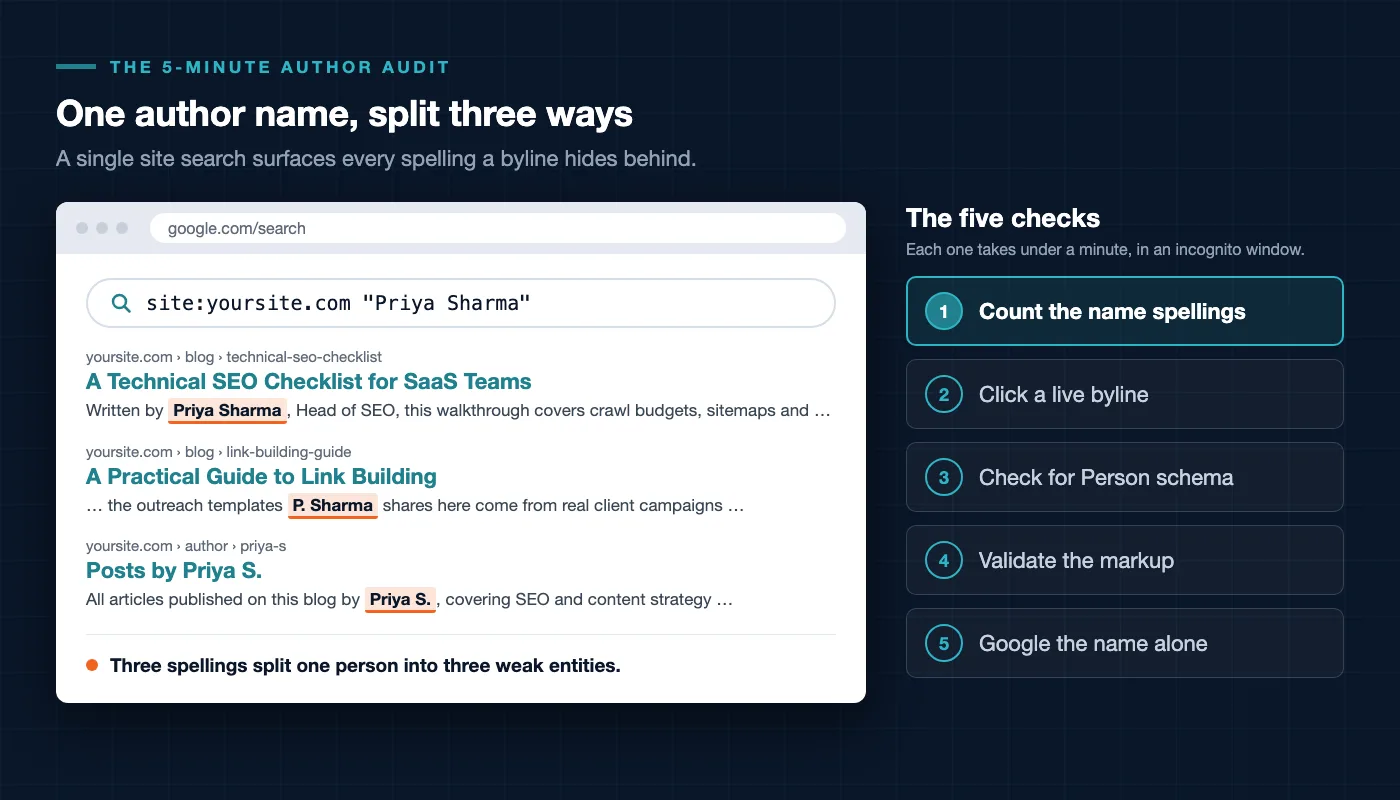
Before you build anything, find out what’s broken. Open an incognito window and run these five checks on your main author. Each one takes under a minute.
- Count the name spellings. Search Google for
site:yoursite.com "Author Name", then try the short forms. If “Priya Sharma”, “P. Sharma”, and “Priya S.” all return hits, you’ve split one person into three weak entities. - Click a live byline. Open any published post and click the author’s name. Does it land on a real bio page, or does it link to nothing? A dead byline is the most common gap I find.
- Check for Person schema. On the bio page, right-click and view source, then use Ctrl+F to search for
"Person"andsameAs. No match means machines are reading plain text, not a defined entity. - Validate the markup. Paste the bio page URL into Google’s Rich Results Test. If the Person block errors out or shows no
sameAsprofiles, note it as a fix. - Google the name alone. Search just the author’s full name. Does their LinkedIn rank on page one? Any hint of a knowledge panel? That tells you how recognisable the entity already is.
Write down every “no”. Those become your task list for the next section. Most sites fail three of the five, and the fixes are quick.
Build an author entity Google can verify
Author authority isn’t one action. It’s a set of signals that agree with each other. When they line up, a machine connects the dots with confidence. Here’s how to set each one.
Lock in one exact name everywhere
Pick the exact name each expert will use, then never vary it. Decide “Vinay Upadhyay” and drop “V. Upadhyay” and “Vinay U.” for good.
Now push that spelling everywhere the person appears. Site bylines, the WordPress user profile, LinkedIn, conference bios, podcast show notes, guest posts. Every matching mention is another vote that this person is real and does this work. Fix your own site first, since that’s the part you control today.
Build a bio page that acts as the entity home
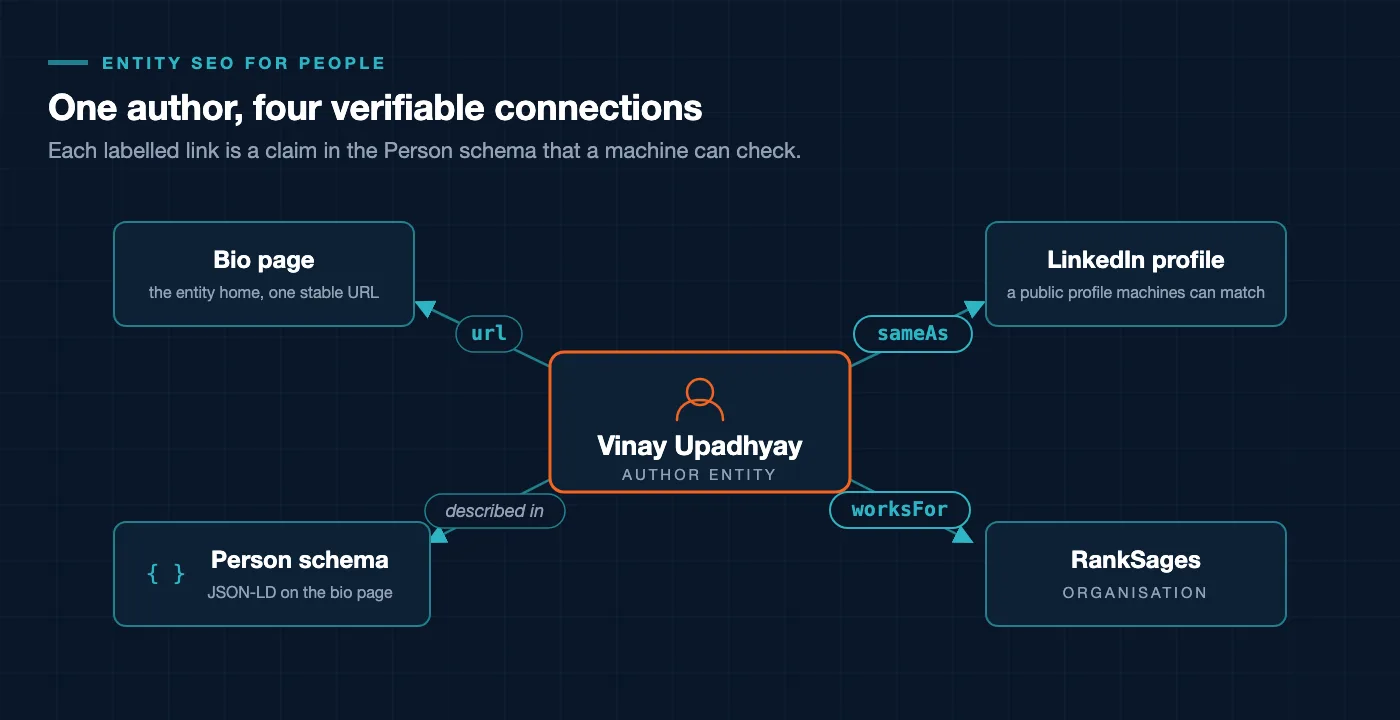
The bio page is the author’s home address on the web. It’s the one stable URL everything else points back to, so a one-line bio wastes it.
Give the page real substance. A strong author bio page includes:
- Their exact name, current role, and years of hands-on experience.
- Specific credentials, the fields they’ve worked in, and the types of clients they’ve served.
- A genuine photo of the actual person, not a stock headshot.
- Outbound links to their LinkedIn and other professional profiles.
- A list of the articles they’ve written, so their expertise has a paper trail.
Write it in the first person where you can. Picture a small B2B SaaS site with one lead writer. Her bio should read like she wrote it about her own career, because she did, and it should link to every post under her name.
Add Person schema with sameAs profile links
Schema markup hands machines a clean, structured version of that bio. Use the Person type, and treat the sameAs property as the star of the show.
sameAs lists the same person’s other profiles. It states, in plain code, “this author is also that LinkedIn account and that X profile.” That’s the line that turns a floating byline into a connected node. Drop this JSON-LD in the bio page head and swap the placeholders for real URLs.
{
  "@context": "https://schema.org",
  "@type": "Person",
  "name": "Vinay Upadhyay",
  "jobTitle": "Founder, Head of AI Search Optimization",
  "url": "https://ranksages.com/about-us/",
  "image": "https://ranksages.com/img/vinay-upadhyay.jpg",
  "worksFor": {
    "@type": "Organization",
    "name": "RankSages",
    "url": "https://ranksages.com/"
  },
  "knowsAbout": ["SEO", "AI Search Optimization", "Content Strategy"],
  "sameAs": [
    "https://www.linkedin.com/in/your-profile/",
    "https://x.com/your-handle"
  ]
}
Test it in Google’s Rich Results Test before you move on. If you want the fundamentals first, start with our schema markup guide, then wire the same author into your article schema with an author field that references this Person.
Put real credentials and firsthand experience in the writing
Schema declares expertise. The article has to prove it. This is where most brands fall down.
Generic advice reads like it came from anywhere. Experience reads like it came from someone who did the work. So name the specific situation, the mistake you made, the tool you actually used, the result you watched happen. A dentist writing about patient no-shows should mention the reminder system she tried and what it changed, not just “reminders help.”
Link the author and the brand both ways
The person and the company should point at each other. Three links make that connection solid:
- The bio page links out to the organisation’s home or about page.
- The organisation’s about page names the expert and links to their bio.
- The Person schema uses
worksForto state the employer, as in the snippet above.
That mutual link strengthens both entities. Google sees a person tied to a known brand, and the brand backed by named humans.
Author authority mistakes that quietly sink you
I see the same errors site after site. Any one of them can undo the work above.
- Fake or AI-generated personas. A made-up author with a stock face and no real profiles has nothing to verify. It’s a liability, not a signal, and one discovery taints everything else you publish.
- Ghost bylines. Crediting every post to a founder who never wrote a word opens a gap between the claim and the reality. That gap is fragile.
- Thin bio pages. One sentence and zero links wastes the entity’s home. Google has nothing to work with.
- Inconsistent names. Three spellings across the site split one strong person into three weak ones.
- No profile links. Without
sameAspointing somewhere real, your author floats with no anchor to the wider web.
Notice the theme. Every mistake breaks the chain between a claim and something a machine can check. Keep the chain intact and you stay ahead of most competitors.
The 10-point pre-publish author checklist
Run each expert through this before anything goes out under their name. If you can’t tick a box, that’s your next task.
- The author’s name is spelled identically on every page and profile.
- A dedicated bio page exists at a stable, unchanging URL.
- The bio names their role, focus, and years of real experience.
- A genuine photo of the person sits on the bio page.
- Person schema is live, and it validates in the Rich Results Test.
- The schema includes
sameAslinks to LinkedIn and other profiles. - The bio links to the organisation, and the organisation names the author.
- Each article uses author markup that ties the content to this person.
- The draft shows firsthand detail only this writer could provide.
- Every post links back to the author’s bio page.
Experience is the signal you can’t fake
Anyone can claim expertise. You can buy a certificate, pad a bio, or spin up a persona in seconds. Those signals keep getting cheaper to counterfeit.
Firsthand experience is different. You either ran the campaign, shipped the product, and sat with the client, or you didn’t. That texture is hard to fabricate and easy to spot.
So build the entity Google can verify, then fill the writing with what your experts have actually lived. Start with one author this week, run the five-minute audit, and fix the first gap you find. Small, consistent moves compound into an author authority that both search engines and AI answers learn to trust.
Frequently Asked Questions
What is author authority in SEO
Author authority is how much Google and AI systems trust the specific person credited with a piece of content. It grows from a consistent identity, a real bio page, verified profiles, and writing that shows genuine firsthand experience.
Does author schema directly boost rankings
Person schema isn’t a guaranteed ranking lever on its own. It helps machines identify and connect your author as an entity, which supports the trust signals Google already weighs. Treat it as clarity for search engines, not a magic switch.
Can I use AI-generated author personas
In my experience, avoid it. A fake persona has no real profiles, no verifiable history, and nothing behind the claimed experience. If it’s discovered, it damages trust in everything else you publish, so credit real people instead.
How long until author authority pays off
It builds slowly, like any trust signal. Consistent bylines, an active LinkedIn, and repeated coverage of the same topics compound over months. There’s no fixed timeline, but most of the setup is a one-time cost that keeps paying.
What’s the fastest first step
Build one strong bio page for your main expert and add Person schema with sameAs links. Then make sure every post they write points back to it. That single home base does more than any other quick fix.