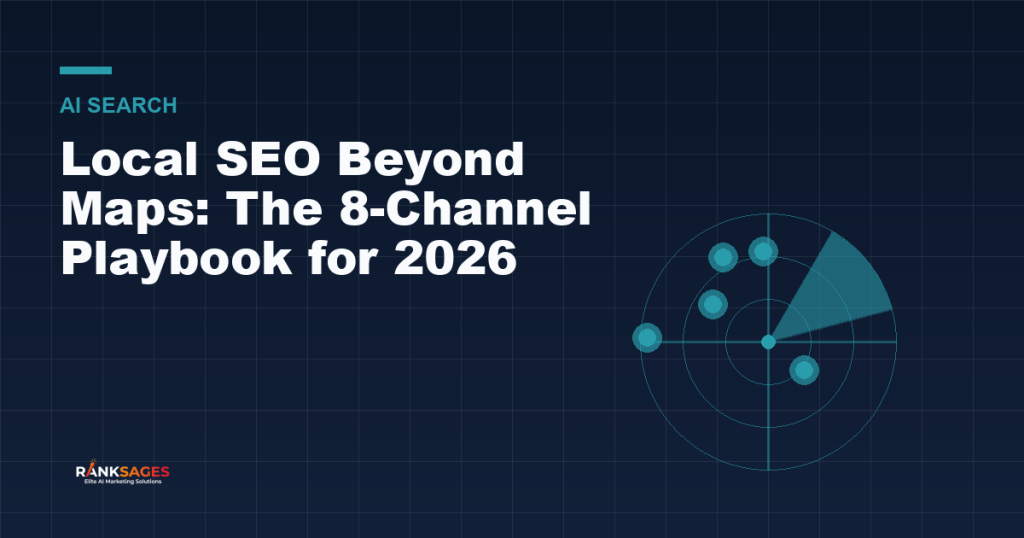
AI search engines are quietly eating the local pack. 41% of "near me" searches now produce an AI-generated answer before users see Google Maps.
For 20 years, local SEO meant ranking in the Google Map Pack. In 2026, that is still the largest single source of local traffic but no longer the only one. AI search engines, voice assistants, and Apple Maps are quietly capturing a growing share of “near me” intent, and the optimization signals they read are different from what wins in Google Maps. Here is the integrated local + AI strategy that service businesses need now.
The new local search landscape
Related deep-dive: Working a regional market? Our Miami SEO playbook shows how this 8-channel framework plays out for South Florida service businesses, neighborhood by neighborhood.
A user looking for a plumber, lawyer, dentist, or restaurant in 2026 might start in any of these places:
Google Maps still dominates, but the 23% of queries going to AI engines and voice assistants are typically higher-intent (the user has a specific need and is comparing options) which makes them disproportionately valuable for conversion.
What AI search engines look at for local recommendations
AI engines do not “rank” local businesses the same way Google Maps does. They synthesize a recommendation from multiple sources. Reverse-engineering 50+ AI search local recommendations across service categories, the consistent inputs are:
- Structured data on the business website (LocalBusiness schema with all properties filled)
- Citation density and consistency across the web (NAP, business descriptions, services offered)
- Recent positive reviews with substantive text (not just star ratings, the actual review content)
- Editorial mentions in trusted local sources (neighborhood blogs, local news, “best of” lists)
- Wikipedia or Wikidata entry if applicable
- Industry-specific authoritative directories (Avvo for legal, Healthgrades for medical, etc.)

The 8-point local + AI optimization framework
1. LocalBusiness schema completeness
Most local sites have basic LocalBusiness schema but miss the high-value properties: geo coordinates, opening hours specification, services offered, payment accepted, accessibility features, areaServed. Completing all properties is a 30-minute task that meaningfully increases AI search citation rates.
2. Google Business Profile is the foundation, not the whole strategy
A complete optimized GBP is necessary but no longer sufficient. It serves Google Maps and as a citation source for AI engines, but does not directly influence ChatGPT, Perplexity, or AI Overview recommendations.
3. Review velocity AND review content
For Google Maps: review count and recency drive ranking. For AI search: review content matters more. AI engines extract sentiment, specific service mentions, and pain-point language from review text. Encourage customers to mention what specifically they appreciated and which services they used.
4. Service-specific landing pages
A single “Services” page that mentions 12 services is far weaker than 12 dedicated service pages, each with: definition of the service, when someone needs it, pricing context, examples of past work, and location served. AI engines cite service-specific pages, not generic overviews.
5. Neighborhood-level content
City-level local SEO is now mature in most markets. The next layer is neighborhood: pages about your service in specific neighborhoods, with real local references (landmarks, common housing types, transit, regulations specific to that neighborhood).
6. Editorial mentions strategy
Get featured in local “best of” lists, neighborhood newsletters, local news sites, and industry publications. These are citation gold for AI engines and they also drive direct traffic. Three high-quality editorial mentions outweigh 50 generic directory listings.
7. Question-format content matching voice search
Voice queries are conversational: “Who is the best dentist in Carlton that takes new patients?” Build content that answers these natural questions in natural language. Use FAQ schema for the question-answer pairs.
8. Industry-specific authority signals
Different services have different authoritative directories. Legal: Avvo, Martindale, state bar. Medical: Healthgrades, Vitals, Doximity. Home services: HomeAdvisor, Houzz. Get complete profiles on the 2-3 most authoritative for your industry, not 50 random directories.
What the integration looks like for a single service business
A dental practice in Melbourne implementing this framework would have:
- Optimized Google Business Profile with all 9 sections complete
- Service-specific landing pages: general dentistry, cosmetic, orthodontics, emergency, pediatric, implants
- Neighborhood pages: Carlton, Brunswick, Fitzroy, North Melbourne (each with unique local content)
- FAQ schema covering 30+ common patient questions
- Active review acquisition with prompts that encourage substantive feedback
- Healthgrades, RateMDs, Australian Dental Association directory profiles
- Editorial mentions in 2-3 Melbourne family/lifestyle publications
- Person schema for each dentist with credentials, education, knowsAbout, sameAs to AHPRA registration
This setup typically takes 60-90 days to implement and produces visibility across Google Maps, AI search, voice assistants, and industry directories simultaneously.
The eight-channel local visibility framework
Most local SEO programs in 2026 still optimize for one channel: Google Maps. The framework below covers all eight surfaces where service businesses can earn visibility, with the specific signal each one cares about.
Optimizing for each channel: the unique signal that matters
- Google Maps: Primary GBP category (60-70% weight), review quantity + velocity, NAP consistency, proximity to searcher.
- Google AI Overviews (local): LocalBusiness schema completeness, original content beyond GBP, editorial mentions in local publications.
- ChatGPT and Perplexity: Wikidata presence, citation density across the open web, structured data, brand entity strength.
- Apple Maps: Apple Business Connect listing (separate from GBP), Yelp data (Apple sources from Yelp heavily), original photos.
- Voice assistants: FAQ schema, natural language content matching how people actually speak queries, business-hour data accuracy.
- Industry directories: Vertical-specific (Avvo for legal, Healthgrades for medical, Houzz for home services). Complete profiles, claimed listings, response to inquiries.
- TikTok / social discovery: Geo-tagged short video content, location-tagged posts, hashtag use combining service + city.
- Bing Local + Microsoft Copilot: Bing Places for Business listing (still under-claimed by most local businesses), Bing-specific schema validation.
The 90-day implementation sequence for a service business
The order matters because each phase builds on the previous one’s data and authority. This is the exact sequence we run on new local SEO engagements.
Days 1-30: Foundation
- Complete Google Business Profile across all 9 sections, including services list, products, and Q&A
- Audit and fix NAP across the top 25 citation sources for the industry
- Add or fix LocalBusiness schema on the website (geo coordinates, opening hours, services offered, payment accepted, areaServed)
- Launch review acquisition workflow (post-service email or text with direct review link)
- Claim or update Apple Business Connect and Bing Places listings
Days 31-60: Content + Multi-Surface
- Build service-specific landing pages (one per service, each with FAQ schema)
- Build neighborhood pages for top-3 service areas (each with unique local data, not just city-name swaps)
- Claim industry-specific directories (Avvo, Healthgrades, Houzz, etc. depending on vertical)
- Launch citation cleanup pass via Yext, BrightLocal, or manual
- Begin editorial outreach to 5-10 local blogs or news sites for mentions
Days 61-90: Authority + AI Search
- Build Wikidata entity entry for the business
- Complete Person schema for owner/principal practitioners with credentials
- Add 15-25 FAQ items across the site (matched to common voice queries)
- Track AI engine citation share weekly (ChatGPT, Perplexity, Google AI Overviews)
- Begin video content for TikTok and YouTube Shorts (geo-tagged)
Five common Local SEO mistakes that cap visibility in 2026
Local service businesses with strong NAP consistency and decent reviews still routinely under-perform. These five issues are the most common causes we find in audits.
Mistake 1: Wrong primary GBP category
The primary category drives 60-70% of local pack ranking signals. A “dental clinic” miscategorized as “medical clinic” loses dental searches to competitors with the correct primary. Audit your primary against the closest match for your revenue-driving service.
Mistake 2: Treating every channel like Google Maps
What ranks in Google Maps (proximity, primary category, review velocity) is different from what gets cited in AI Overviews (LocalBusiness schema, editorial mentions, Wikidata). Same business, different optimization needs per channel.
Mistake 3: Generic neighborhood pages
“We serve Carlton, Brunswick, Fitzroy” repeated 30 times for 30 neighborhood landing pages is thin content. The fix: each neighborhood page needs unique local data, real local references, and ideally a real local case study from that neighborhood.
Mistake 4: Industry directory neglect
Yelp, Avvo, Healthgrades, Houzz, etc. are not optional. AI engines pull data from these as authority signals. A complete profile on the 2-3 most relevant industry directories outweighs 50 generic citation listings.
Mistake 5: Review velocity neglect
Reviews matter more than ever in 2026 because AI engines extract sentiment and service mentions from review text. Steady velocity (1-2 reviews per week) outperforms a one-time burst. Set up automated post-service review prompts.
Case study: Melbourne dental practice, 4x lead growth in 6 months
A Melbourne dental practice with 4 locations engaged RankSages in October 2025 with a stalled local SEO program. They ranked in the local pack for some queries but had zero AI engine citations. Six months in:
- Google Map Pack rankings improved from average position 4.2 to 1.8 across core queries
- 3 cited AI Overview placements for “best dentist Carlton”, “emergency dental Melbourne”, “cosmetic dentistry CBD”
- Apple Maps + Yelp profile clicks grew 280%
- Qualified leads from organic + map increased from 38/month to 152/month
The interventions:
- Month 1: Switched primary GBP category from “Medical clinic” to “Dentist”. Optimized all 4 locations identically. Built unique neighborhood pages for each location’s service area.
- Month 2: Complete LocalBusiness schema on each location page with geo coordinates, services offered, opening hours, payment accepted, accessibility.
- Month 3: Added Person schema for each named dentist with credentials, alma mater, AHPRA registration, specialties.
- Month 4: Built Wikidata entry for the practice. Launched review acquisition workflow (post-appointment text with direct review link). Got featured in two Melbourne family-living blogs.
- Months 5-6: Launched TikTok content series for one location. Added FAQ schema covering 30+ common patient questions.
Industry-specific local SEO patterns for 2026
Generic local SEO advice (claim your GBP, get reviews, optimize NAP) covers the basics but misses what actually moves rankings in specific verticals. The patterns below come from our active client portfolio across the most common local service categories.
Legal services
The most competitive local SEO vertical in most markets. What actually works in 2026: practice-area-specific landing pages (one per practice area in each location), Avvo and Martindale profiles fully completed, Wikipedia entries for senior partners where notability allows, case results pages with verifiable outcomes, attorney Person schema with bar registration numbers, named case studies (anonymized as required by ethics rules).
The biggest mistake: generic “personal injury lawyer” pages without practice-area depth. Specific practice areas (motorcycle accidents, workers compensation, medical malpractice, premises liability) rank far better than the umbrella term and convert at higher rates.
Medical and dental practices
YMYL bar is the highest. Required: provider Person schema with credentials, licensing body registration, malpractice insurance disclosure, named medical reviewer for any condition-related content, before/after photography with patient consent (for cosmetic procedures), accepted insurance plans listed explicitly.
AI engines cite medical practices much more cautiously than other businesses. Wikidata entries, Healthgrades profiles, and consistent NAP across medical-specific directories (Vitals, Doximity, RateMDs) are the strongest AI citation signals.
Home services (plumbing, HVAC, electrical, roofing)
Competition is intense in major metros. What separates winners: emergency-availability schema markup (24/7 service hours when accurate), service-area schema with explicit cities, fleet vehicle photos as Experience signal, before/after job photography, licensed-contractor credentials visible on every page, BBB accreditation status, Angi/HomeAdvisor Pro listings claimed.
The new differentiator in 2026: TikTok and YouTube Shorts content from job sites. Geo-tagged short video content from real jobs drives discovery on social search and creates Experience signals that traditional content cannot match.
Restaurants and hospitality
Maps-driven heavily. Critical: hours accuracy (Google penalizes wrong hours hard), menu visibility in GBP, original food photography (not stock), reservation integration (OpenTable, Resy linked from GBP), review-velocity maintenance (post-visit text reminders), and special-occasion pages (private events, catering) for higher-margin queries.
AI search citation pattern: restaurants get cited based on review sentiment density. Reviews that explicitly mention dishes, ambiance, and occasion fit produce far more AI engine references than star-rating-only reviews.
Real estate
Hyper-local by definition. What works: agent Person schema with brokerage affiliation, neighborhood pages with actual market data (median prices, days on market, demographic notes), client testimonials with named properties (where allowed), MLS integration showing live listings, agent-specific case studies of properties sold.
Avoid generic city-wide content. Hyperlocal beats general in real estate more than any other vertical.
Voice search optimization that actually works
Voice search accounts for a growing share of local queries. Optimization for voice differs from optimization for text in three specific ways:
Natural language Q&A format
Voice queries are conversational: “Who is the best dentist near me that takes Aetna insurance?” not “best dentist near me Aetna”. Build FAQ schema with natural-language question phrasing matching how people actually speak. Voice assistants extract answers from these structured Q&A pairs.
40-60 word answer length
Voice assistants read answers aloud. Answers that exceed 60 words get cut off mid-sentence, which voice assistants then deprioritize. Format the answer in your FAQ schema as a 40-60 word self-contained response.
Local context built into the answer
Voice queries often include implicit local context (“near me”). The answer should explicitly reference the location served. A dental practice in Melbourne should have FAQs answering “best dentist in Melbourne” naturally, with the city name in the answer text not just the question.
The local SEO 30-60-90 day roadmap
A successful local SEO program in 2026 follows a predictable rhythm. The 30-60-90 day pattern that we run on every new local engagement, with the specific outcomes to expect at each milestone.
Day 30 outcomes
- Google Business Profile fully optimized across all sections, primary category corrected if needed
- NAP consistent across the top 25 citation sources for the industry
- LocalBusiness schema complete on the website with geo coordinates, opening hours, services, payment methods
- Review acquisition workflow live with at least 3-5 new reviews this month
- Apple Business Connect listing claimed and optimized
Day 60 outcomes
- Service-specific landing pages live for top 5 services
- 2-3 neighborhood pages live with unique local content
- Industry-specific directory profiles claimed and optimized
- FAQ schema covering top 15 voice-search-style questions
- Google Map Pack rankings improving on tracked queries (typical: 2-4 positions gained)
Day 90 outcomes
- Wikidata entity entry created for the business
- Person schema complete for all named practitioners with credentials
- First AI engine citations appearing (Google AI Overviews, ChatGPT, Perplexity) on industry-specific local queries
- Editorial mentions secured in 2-3 local publications
- Review velocity at 10-15 new reviews per month
- Map Pack rankings consistently in top 3 for primary commercial queries
Engagements that hit these milestones at each checkpoint typically see 200-400% lead growth from organic sources by month 6. Engagements that miss milestones usually need diagnostic re-work before scaling further. The pattern is consistent across the dozens of local service businesses we have worked with through this framework.
FAQ
Will AI search replace Google Maps for local search?
Not in the near term. Google Maps remains the most efficient interface for local discovery (map view, photos, directions, reviews). AI search engines complement rather than replace it for users who want a recommendation instead of a list.
How important is GBP for AI search visibility?
Significant but indirect. GBP is a high-authority citation source that AI engines reference, but it does not directly feed AI recommendations the way it feeds Google Maps. The business website plus citations across the web matter more for AI visibility.
What is the single highest-ROI action for a service business in 2026?
Completing LocalBusiness schema on the website and ensuring NAP consistency across the top 25 industry-relevant citation sources. These two together address both Google Maps ranking and AI engine citation eligibility.
Related deep-dive: New York agencies and businesses can see our New York SEO playbook for borough-specific patterns (Manhattan, Brooklyn, Queens) and dense-competition strategy.
Related deep-dive: For multi-region campaigns in Southern California, our Los Angeles SEO playbook walks through how to handle service-area vs. storefront markets in the same account.
Related deep-dive — NYC SEO Agency: Multi-borough Local SEO strategy in the densest US metro market. Read more →
Related deep-dive — London SEO Agency: UK's most competitive local market. Same 8-channel framework, British nuances. Read more →
Related deep-dive — Melbourne SEO Agency: Suburb-level Local SEO across Victoria. Read more →

Frequently asked questions
Will AI search replace Google Maps for local search?
Not in the near term. Google Maps remains the most efficient interface for local discovery (map view, photos, directions, reviews). AI search engines complement rather than replace it for users who want a recommendation instead of a list.
How important is GBP for AI search visibility?
Significant but indirect. GBP is a high-authority citation source that AI engines reference, but it does not directly feed AI recommendations the way it feeds Google Maps. The business website plus citations across the web matter more for AI visibility.
What is the single highest-ROI action for a service business in 2026?
Completing LocalBusiness schema on the website and ensuring NAP consistency across the top 25 industry-relevant citation sources. These two together address both Google Maps ranking and AI engine citation eligibility.